Interview by Femme Art Review
EVERYTHING COMES BACK AROUND: IN CONVERSATION WITH NILOUFAR FALLAHFAR

Interview by Adi Berardini
Niloufar Fallahfar approaches painting in an inventive way—rather than as a 2D painting on the wall, she asks the viewer to engage with the work as a 3D object. Like the Möbius strip is constantly moving, Fallahfar views history as constantly ebbing and flowing. She aims to create an immersive experience for viewers, inspired by sculpture, Iranian history, and Persian architecture of domes and transitional zones. Fallahfar is inspired by the hope that Iranian Shahnameh poetry can spark during dark times and periods of tyranny. Through sparking engagement, Fallahfar articulates a practice grounded in physical and conceptual movement.
Most recently, Fallahfar’s work is on display at the Michigan State University MFA exhibition at the Eli and Edythe Broad Museum, from March 14 to May 17, 2026. Referencing Iranian mirror work, in her exhibition, memory, like the image, is never linear or fully accessible at once and must be assembled through shifting viewpoints and sustained attention.

Your work asks viewers to move around it and see it from different angles. How did you first conceptualize approaching painting in a more sculptural and expanded way?
It goes back to undergrad in Iran, where I was studying painting in university. And it was around 2010 and 2011 that I created my first three-dimensional painting. I made them out of different canvases; I just put them on top of each other. I came to the conclusion that a flat surface is not enough for me, given my curiosity and the questions I wanted to explore in the art world.
I realized that the way we experience life and everything around us is closer to moving through space rather than just looking at the single image, and you don’t access it from just a single fixed point. You return to it, you circle around it, and see different parts at different times.
I feel like that is like history. We move from the past to the present while we are heading towards the future. So, in this situation, time and place play a special role in my work, and I aim to construct a situation for the audience to enter a space and move and adjust their situation in front of an artwork, which I call sculptural painting, to actively participate in the work.
I feel that, as a painter, too. Sometimes, you want to move beyond the flat surface. And I think you’ve done that so well. As you describe, you are interested in exploring how fragments can take spatial form. Can you explain how your work is influenced by Persian cultural memory and history, especially when cultural histories can be fragmented, yet resist attempts at erasure?
I feel like that Persian cultural memory is very layered, but also very fragile at the same time in certain ways.
I grew up in Iran, and I experienced how history is constantly controlled, and because of that, I think memory doesn’t exist as a stable or continuous narrative. I feel like it survives in fragments, stories, images, architecture, poetry, and many things that we have in our culture.
And what interests me is that even when these traces of memory are suppressed, they don’t disappear; they just reappear in different forms. So, in my work, I’m not trying to reconstruct a unified historical narrative. I’m more interested in how these fragments can exist, especially in the architectural forms that I was inspired by my home country, Persian architectural forms like threshold domes and transitional spaces that we have.
This becomes a container for the fragments that I’m talking about—They hold different temporal layers at once. So, I think these works reflect this condition where memory is incomplete, and narration is inadequate. I believe it’s kind of stuttered, but it’s still active and resisted. It cannot be fully erased. We can see through history that it is reappearing again.
In my work, I’m interested in how these mythological ways of understanding events intersect with the present, and how they remain legible and deeply synchronized within contemporary experience.
Can you expand on your influence of Iranian myths and how they are living components of cultural memory that continue to shape political imagination, such as collective resistance in the face of tyranny?
Iranian mythology, especially in the Shahnameh poem that we have, functions as more than literature. It carries part of the pattern of thinking about power, justice, and resistance. For example, as you mentioned, this story of hope and freedom is not just about the past, it’s recurring.
The mirrored structure, through its repetition, multiplicity, and capacity for confrontation, also carries the experience of fragmentation and collapse through the breaking of light itself. Within that condition, there is also the possibility of overturning what exists and moving beyond it. That idea continues to shape how people imagine political change. In my work, I’m interested in how these mythological ways of understanding events intersect with the present, and how they remain legible and deeply synchronized within contemporary experience. Myths become more than characters; they become symbols that reappear across history, through which people resist oppression and reclaim their lives, their countries, and their freedom from tyranny. So, when I use these references, I’m not just illustrating the mythology in my work. I’m activating this as a living system of meaning. That kind of continues to inform how people understand oppression and resistance today, especially in my country, Iran, where we faced a lot. To know that they can resist and ultimately overcome the darkness.
And as an Iranian, we believe that light will once again triumph over darkness in history again and again. And this is the kind of hope that we have in our Shahnameh literature and all those mythologies that we have.

That’s so important to have too. The stories and the myths that kind of give you hope in those times as well. It seems inventive how you were inspired by the Möbius strip.
As I mentioned earlier, I believe that history continuously repeats itself in different forms. In Infinite Action Number II, as well as in an earlier work titled Infinite Action, which I created in Iran, I explore this cyclical condition of history. That earlier work was also connected to a social and political subject. Here, I return once again to the form of the Möbius strip to express the idea that history moves in loops, where patterns continuously reappear across time. In Persian poetry, Hafez writes, “Be joyful, for the tyrant will never find the path home.” I incorporated this verse into Infinite Action Number II because, for many Iranians, it carries a sense of hope across generations. Throughout history, people continue to believe that oppressive structures can eventually be overcome.
What interests me about the Möbius strip is its ability to overturn the relationship between inside and outside. Within one continuous surface, a transformation occurs where interior and exterior collapse into one another, producing a third space and condition. Simultaneously, repetition, transformation, and coexistence take place. This logic strongly resonates with my understanding of history, memory, and the recurring return of myth across time. The meaning embedded in the Möbius form connects deeply with my interpretation of how myth reemerges throughout history. That is why I wanted to return to this structure once again and create a new work through it. Considering all of these ideas, I chose to place the work on a mirrored surface. The mirror not only multiplies the sense of duality, historical looping, and transformation, but also introduces the question of selfhood and confrontation with oneself through historical and mythological reflection. As viewers search for the painted imagery across the surface of the Möbius strip, they inevitably encounter their own reflection in the mirror beneath it. In this way, the present moment becomes connected to the histories and mythologies referenced within the painting itself, much like that poem.
Across the Möbius strip, viewers encounter fragmented scenes and shifting moments of life. Birds appear alongside human figures and layered imagery. A repeated female figure with flowing hair emerges across parts of the surface. Numerous lines pass through her hair, as though she is attempting to shield herself from bombardment. This work reflects experiences that many of us in Iran have lived through. More than three years ago, Mahsa Amini was killed by the government in Iran for allegedly not wearing the “proper” hijab. Following her death, protests erupted across the country. People came into the streets demanding freedom, and the government responded with violence. People were blinded, imprisoned, tortured, and executed.
I believe that when oppression reaches a certain point, when people have been suppressed for so long and experience imposed systems controlling their lives, resistance inevitably emerges. People rise to reclaim their freedom and their right to exist on their own terms. 3 years later, in January 2026, people once again returned to the streets, this time confronting the regime with even greater force and collective resistance. What I want to express through the Möbius structure is that cycles of tyranny also contain the possibility of collapse. Just as in Persian mythology, Fereydun ultimately defeats Zahhak and liberates Iran from tyranny, these historical and mythological patterns continue to resonate in the present. As an Iranian artist, I am not interested in reproducing clichés of suffering. I am far more interested in speaking about the courage and collective strength of my people.
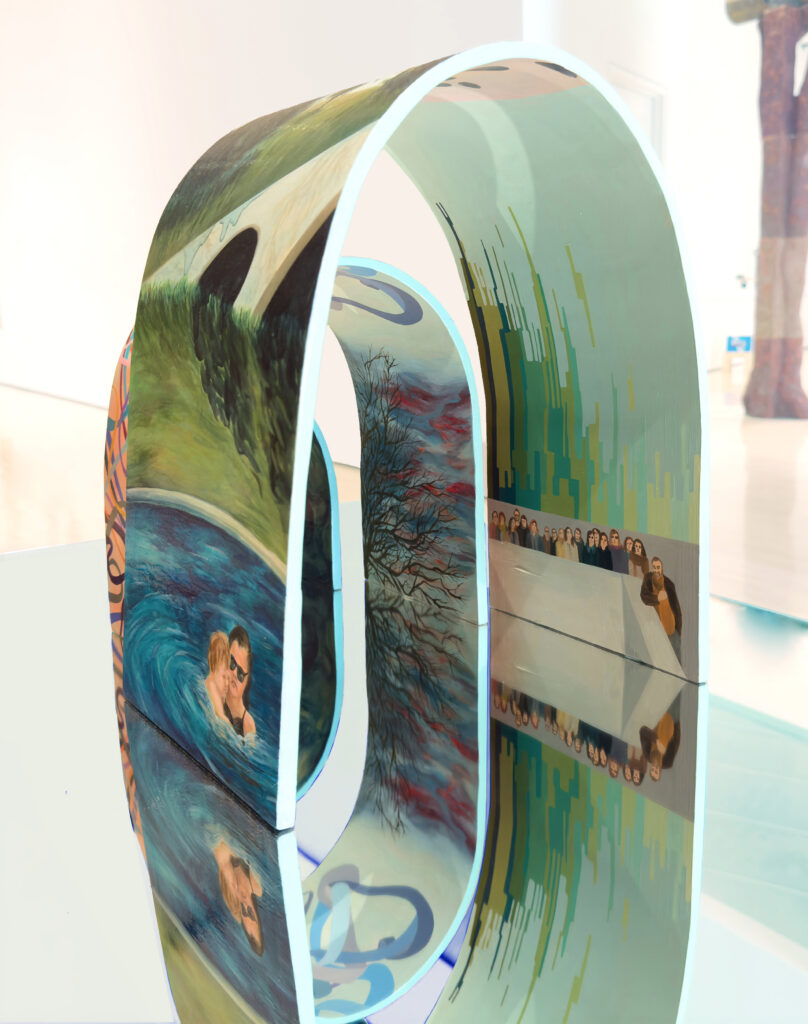
You mention being inspired by the tradition of Persian mirror work, where fragmented reflective surfaces multiply space and destabilize the image. Parts of the work become visible only through reflection, requiring the viewer to move to reconstruct the image. Can you explain more about this influence and how you connect this experience to memory itself?
Persian mirror work is very important to me, but not as a decorative sense to the audience.
What interests me is how it breaks, multiplies space, and makes everything double, and the audience can see themselves in that. In that situation, you never see a single or stable image. You see fragments, reflections, and shifting perspectives. And that experience is very close to how I think memory works.
I feel like that memory is never fully accessible as a complete image. It appears in pieces, and you have to move mentally and physically to reconstruct it. And using the mirror in my work creates a similar condition. Parts of the image are only visible through reflection, and the viewer has to move and adjust their position and piece things together to understand it.
The act of things becomes an active process when I bring the mirror into my work as a kind of situation. You become aware that what you are seeing is partial, and that meaning is something you construct through movement and attention. So, the audience can see themselves, see the fragments, and they balance everything, and in a different moment and time and space works here together.

Niloufar Fallahfar’s thesis exhibition as part of the MFA Exhibition at the Eli and Edythe Broad Art Museum. Photo by Alex Nichols courtesy of the artist.
Do you have any other artists or inspirations you’d like to discuss?
There are several influences in my work, but I think they are more related to ways of thinking about space and experience rather than direct references. Kamāl ud-Dīn Behzād has been very important to me, especially in the way space moves in his miniature paintings and how the viewer experiences different moments and perspectives at the same time instead of from one fixed viewpoint. I’m also interested in artists who challenge stable perspectives and create situations where the audience becomes part of the work physically. At the same time, Persian architecture, poetry, and cultural memory deeply influence on my work. I think what interests me most is how historical forms can still remain alive within contemporary experience. I don’t want to just mention one artist, but there are several of them that shape how I think about the space and how I can create or contract a situation for people to enter, and it’s influence between contemporary practice and historical forms.
Do you have any other upcoming events or news you’d like to share?
I have a group exhibition in the Soil Gallery in Seattle in July. Afterward, in August, I will join another education program.
For my exhibition at the Broad Museum, I was working on different bodies of work developed over time during my years that I was at Michigan State University (MSU), including a sculptural painting and kinetic pieces. I’m really interested in continuing this research and expanding the scale of my work, and further exploring the relationship between movement, architecture, and collective memory.