Lansing City Pulse Reviews MFA Exhibition at the Broad Art Museum
Sleeper of the year
There are at least five different ways photographs can’t do justice to the splendid new exhibit of art by Michigan State University graduate students at the Broad Art Museum.
Either the art is …
●
●
APRIL 8, 2026
MASTER OF FINE ARTS EXHIBITION
Through May 17
MSU Broad Art Museum
547 E. Circle Drive, East Lansing
10 a.m.-6 p.m. Wednesday-Sunday
(517) 884-4800
broadmuseum.msu.edu
ARTIST TALK
6-8 p.m. Wednesday, April 15
Alan and Rebecca Ross Education Wing
Free
MFA Exhibition at MSU Broad opens up five distinct worlds
There are at least five different ways photographs can’t do justice to the splendid new exhibit of art by Michigan State University graduate students at the Broad Art Museum.
Either the art is too big, too immersive, too richly detailed, too three-dimensional, too damn bonkers or some combination of these.
Each year, the Master of Fine Arts Exhibition is the unheralded sleeper in the Broad’s schedule. Anyone who thinks the museum is checking a box as a duty to its university affiliation doesn’t get it. This is the future of art — a chance to step into five absorbing new worlds, fully realized by a diverse group of gifted and committed artists.
The exhibit will be up through May 17. All five artists will be on hand next Wednesday (April 15) to talk about their work.
ADVERTISEMENT
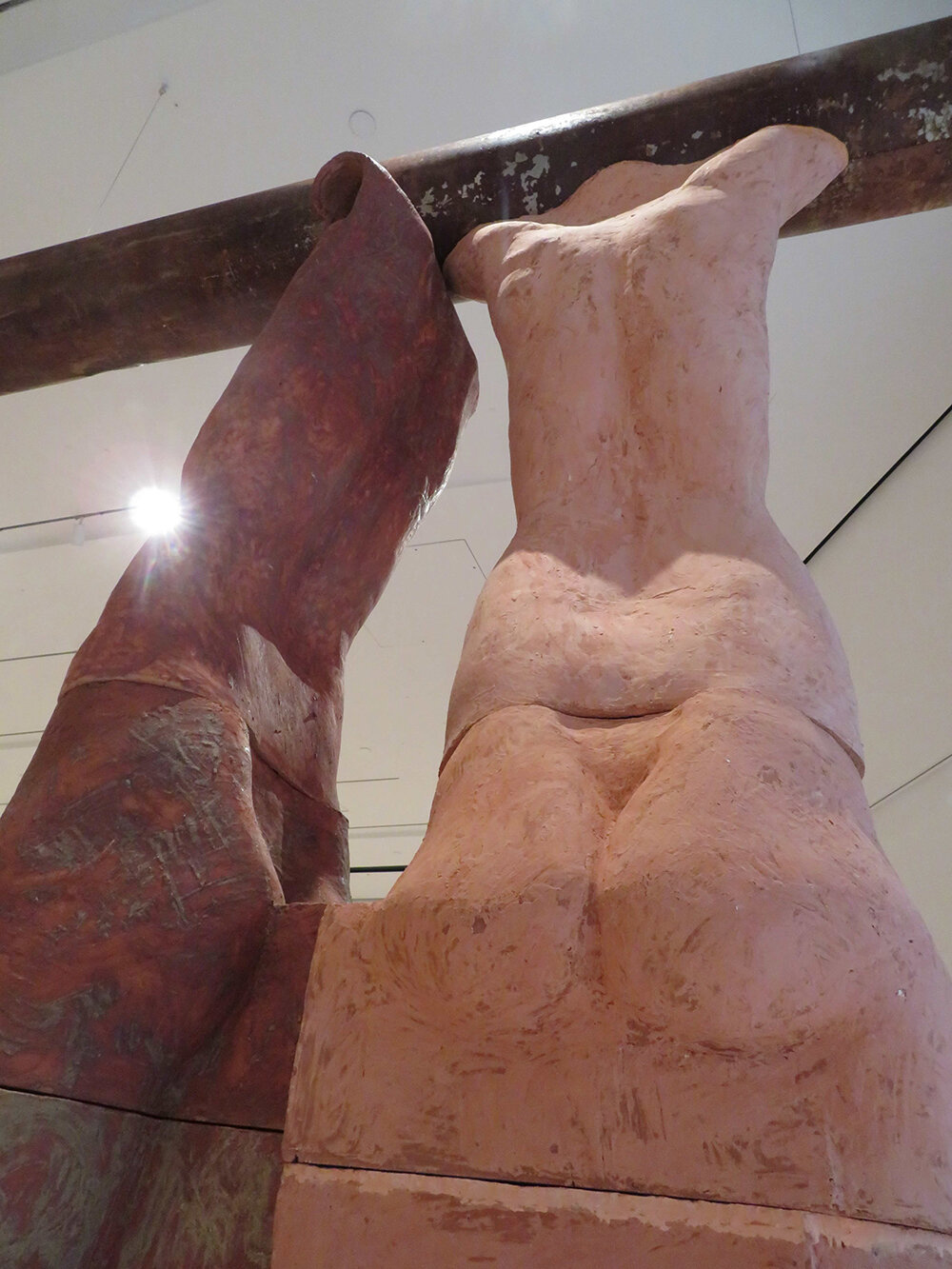
The deeper you look, the more you see, but some things come at you right away. Average-sized visitors will find themselves at about groin level when gazing at “Womb or Tomb,” Ethiopian-born artist Yeroham Ashagre’s imposing quartet of 12-foot-tall ceramic colossi.
The armless, headless torsos are caked with a rusty patina of mystery (actually iron oxide). It’s not the mystery of antiquity, but a modern wonderment over who they are, what they represent and why they are there at all, with their strange proportions, mismatched sections, tortured positioning and overwhelming size.
Impressive as it is, “Womb or Tomb” is arguably the most conventional work of this imaginative exhibit. Parallel curtains made of thousands of gently clattering walnut shells quietly announce a unique installation by Hailey Becker. As you walk between the curtains, a small device glides along the horizontal rod above, generating a soft, rain-like pitter-pattering.
ADVERTISEMENT
The installation and accompanying video deal symbolically with real engineering problems of coastal erosion, as explained in an excellent exhibit booklet by Chicago Tribune art critic Lori Waxman. (Waxman, a 2025-‘26 critic in residence at MSU’s Department of Art, Art History and Design, provides a booklet that’s engaging, informative, personal and blessedly jargon-free.)
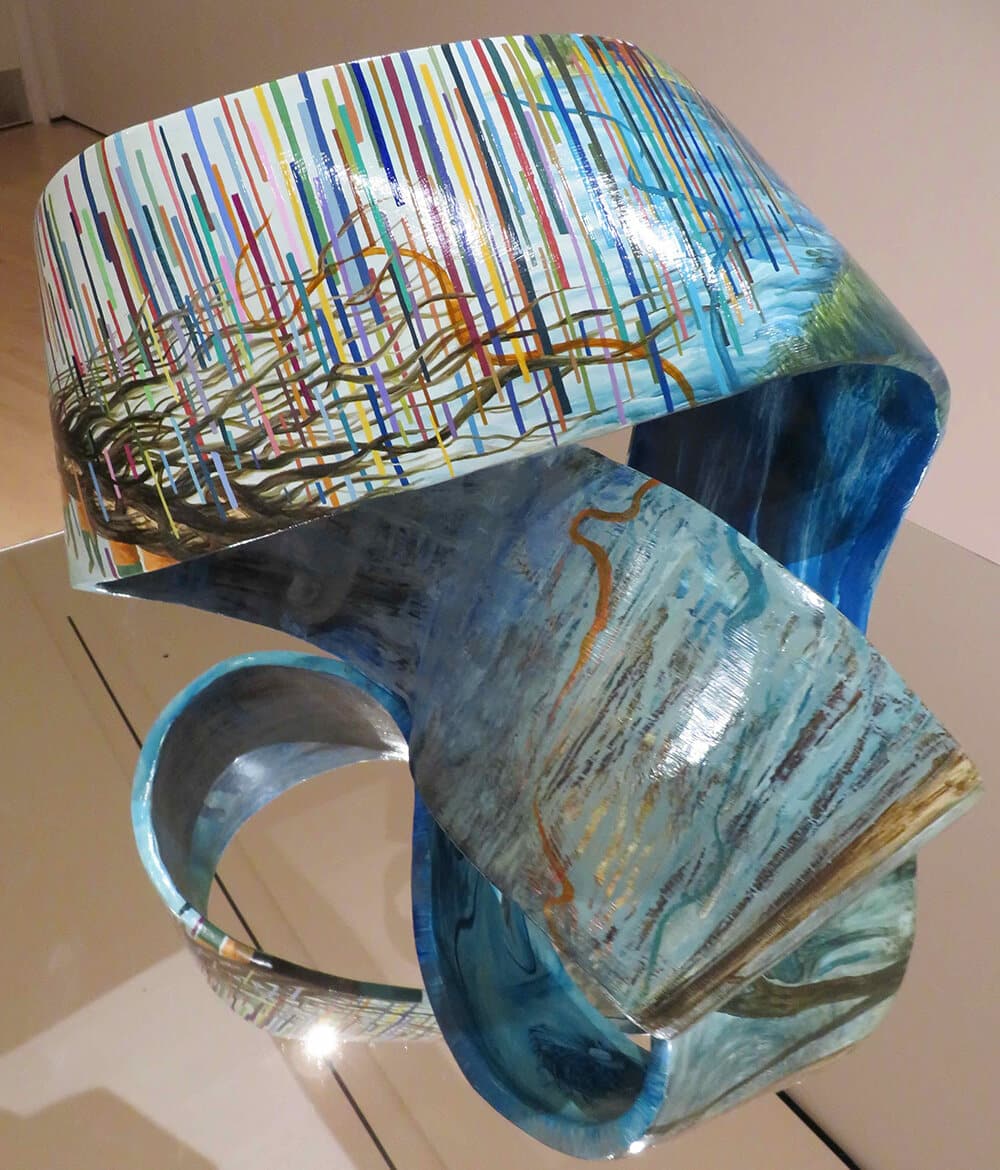
No image can convey the strange comfort and tranquility of Becker’s whispering nutshell curtains. The hybrid painting-sculptures of Iranian-born artist Niloufar Fallahfar find another way to thwart a photographer looking for the “right angle”: They have no right angles.
Fallahfar’s vivid, space-bending panoramas glisten with geometric patterns and dynamic figures, but none of the surfaces are regular. One is a bulbous blob; another is a Möbius strip (a twisted ribbon with only one side); another is a dome you can stand under. The bold colors and strong imagery aren’t just for show. Fallahfar’s dynamic swirls of humanity celebrate unveiled women with liberated hair and a rebel air, defying the mythical and real-life tyrants of ancient Persia and modern Iran.
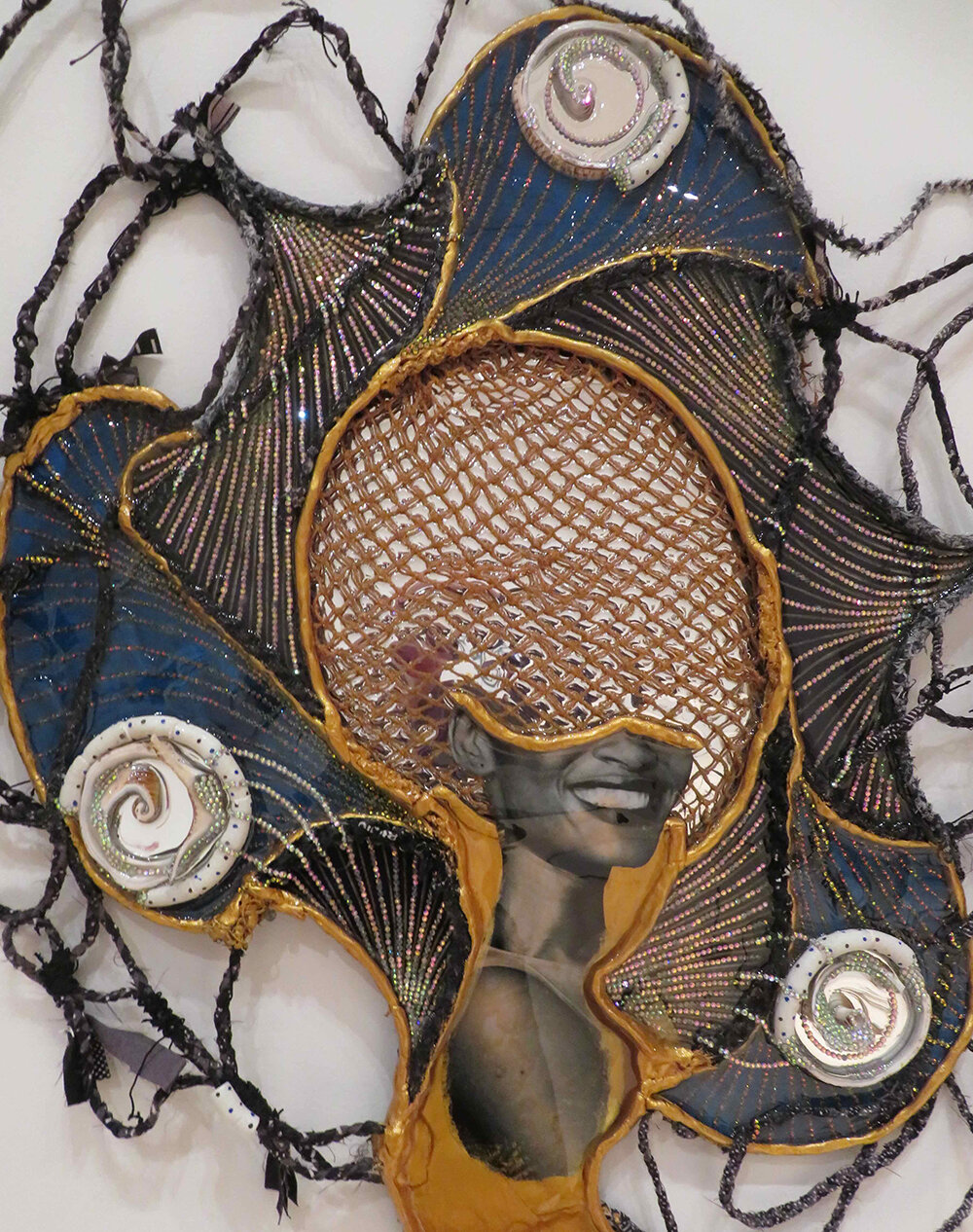
A generous bouquet of gorgeous collages by Vadu Rodrigues challenges the photographer in another way. Rodrigues’ elaborate wall hangings are saturated with details aggregated from color photographs, sequins, textiles, beads, tiny cowrie shells and myriad other sources. Rodrigues comes from Cape Verde, an island nation off the west coast of Africa. The hangings evoke shields, masks, headdresses or super-fancy decorations in an Afro-pop musical star’s dressing room. Every surface ripples and dances with texture, the colors tropically vivid and the blacks and purples deep as outer space.
Thrown into a pool of artists with such a strong aesthetic sense and concentrated sense of purpose, the fifth artist in the group, Alex Vlasov, swims in the opposite direction.
Most artists try like mad to strip away the mental noise of our lives and ignore the blizzard of meaningless scraps that bury meaning and beauty — the advertisements, empty cookie boxes, discarded circuit boards, merchandising allurements and guilt trips, and all the rest of it.
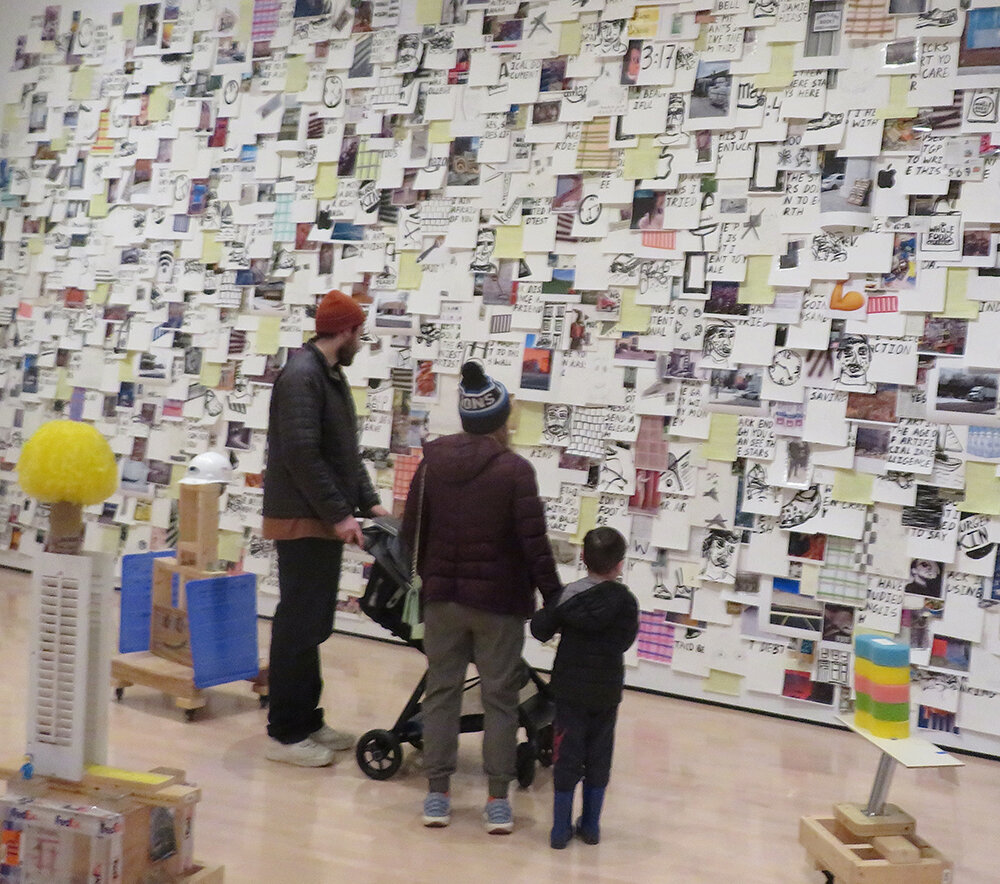
Not Vlasov. He adds it all to the pile. An entire wall of the gallery is covered, floor to ceiling, with thousands of pieces of paper, each one containing an instantly forgettable doodle, image or motto. It’s both overwhelming and underwhelming, as if Vlasov held on to every moment of his life for a year or so without discrimination, preserving every scrap, from a snapshot of an empty strip mall to a quotation by Hannah Arendt to an all-American 2-pound bacon burger. Is he pissing on the very idea of fine art, or just giving up in the face of capitalist excess? One of his handwritten notes reads, “This work made it to the museum.” And it did!
Vlasov’s wall is complemented by a motley array of small sculptures he cobbled together from wood and trash, arranged in mad combinations, some of them fitted with pointless little wheels. A crown of duct tape and tin foil mocks the very concept of majesty. Six colorful, bean-shaped sponges are topped by an attorney’s business card. He could go on and on — and he does.
After all of this overwhelming input, the MFA show leaves you with a brilliant parting shot.
Near Vlasov’s wall of chaos, on a low ledge often used to display sculpture, rests a familiar coffee-to-go cup.
My first thought: “Hey, someone left their coffee.”
But Vlasov got me. It’s part of the exhibit.